
You got engaged. Congratulations.
You’ve probably already told your families, stared at your hand approximately 400 times and had at least one person ask, “So… when’s the wedding?” which is always helpful when you’ve barely had time to process the proposal.
If you’re thinking about getting married in France, this is also the point where a very exciting idea can suddenly turn into a surprisingly large collection of browser tabs. Venue, planner, photographer, flowers, food, music, accommodation, transport and you’re now expected to know what colour napkins you want eighteen months from now. (“Rose decided she wanted lavender. She knows I detest the color.” We hope you got that reference!)
You don’t. And you don’t need to.
The first few weeks of wedding planning are really about making a handful of decisions that allow everything else to fall into place. So if you’ve just got engaged this winter and France is somewhere on your wedding shortlist, here’s where we’d start.
Don’t try to book everything at once
Once the engagement announcement goes out, couples are suddenly surrounded by advice. Book the photographer immediately. Venues are disappearing. You need a planner. Have you thought about flowers? Somebody’s cousin apparently booked their caterer three years in advance.
Ignore the panic.
There are things worth organising early, particularly for a destination wedding, but you do not need seventeen suppliers confirmed by next Tuesday. Start with the decisions that affect everything else, then work outwards from there.
Decide what kind of wedding you actually want
Before opening another venue directory, have one proper conversation together. Not about chair colours, but about the wedding itself.
Do you want 40 people or 140? A château in Provence? A weekend in the Dordogne? A wedding in the Alps? A relaxed garden party? Three days of celebrations? One enormous party? Elegant dinner followed by a very unelegant dancefloor?
Those decisions matter because they shape almost everything that comes afterwards. A 50-person wedding in a private property has completely different requirements from 150 guests at a château, and when it comes to music, they need very different entertainment too. Therefore your visions should be aligned.

Work out a realistic guest number
You don’t need a final guest list, but you do need an approximate number.
There is a huge difference between “we’re probably inviting around 60 people” and “we have 180 names but maybe half won’t come.” Your guest number affects venue capacity, accommodation, catering, transport, budget and the type of entertainment that works later.
Even putting yourselves into a rough bracket 50, 80, 120, 150+ is enough to start making sensible decisions.
Set a budget before falling in love with a château
This is probably the least romantic part of the process, but it may save you a lot of pain later.
Destination weddings can become expensive very quickly because you are rarely only paying for the wedding day. There may be venue hire, several days of catering, accommodation, transport, production, furniture, lighting, entertainment and travel costs for suppliers.
Work out the overall number you are comfortable spending before you start committing to individual elements. It does not need to be an exact spreadsheet yet, but you should know whether you’re planning a €30,000 wedding or a €100,000 wedding before requesting availability from €20,000 venues.
Then choose the region
“France” is not really a wedding location. It is an entire country, and the experience changes enormously depending on where you go.
Provence and the South of France are all about long dinners outside, vineyards, stone properties, warm evenings and a very established destination-wedding industry.
Dordogne gives you beautiful château venues, countryside and often plenty of space for multi-day weddings.
Bordeaux brings vineyards, elegant estates and relatively good international access, while the Loire Valley naturally gives you no shortage of châteaux.
The French Alps work beautifully for both summer and winter weddings, with dramatic scenery and venues where the landscape does a lot of the decorating for you. Lake Annecy gives you the added combination of mountain views and water, which is fairly difficult to beat.
The region also affects supplier logistics. A musician based in the South of France may be an excellent option for Provence but an unnecessarily expensive one for Chamonix, so choosing the region early helps narrow everything else.

The venue comes before most suppliers
Once you know approximately where, when, how many people and roughly what you want to spend, start looking seriously at venues.
Your venue determines your wedding date, accommodation options, catering arrangements and a surprising amount about the entertainment, so this is also the moment to ask about music.
Before signing anything, find out whether you can have amplified music outside, what time it has to stop, whether there is a sound limiter, where the party moves later in the evening, whether there is a built-in sound system, whether live bands are allowed, how much performance space is available and what happens if it rains.
If music is important to you, these are not small details. A beautiful venue with an 11pm music curfew may simply not be the right venue for a couple imagining a party until 2am.
Do you need a wedding planner?
For a destination wedding, often yes, especially if you don’t speak French, live abroad, are planning a multi-day event, are using a private property or simply don’t want wedding planning to become your second job. ( And we can recommend some trusted ones!!)
A good planner already knows the local suppliers, understands French logistics and can tell you very quickly when an idea is realistic or when it is going to involve twelve vans and a temporary electricity supply.
You don’t necessarily need a full planning service either. Some planners offer partial planning or coordination packages if you want to choose most suppliers yourselves but still want someone local to pull everything together.
Book the suppliers you care about most first
There isn’t one universal supplier order because it depends entirely on what matters to you.
If photography is incredibly important, contact the photographer you love early. If you have always wanted a particular wedding band, ask them. If food is the centre of the day, start talking to caterers.
Popular suppliers can book well in advance for summer Saturdays in France, particularly in the busiest wedding regions, so the mistake is assuming that every supplier can wait until six months before the wedding. They can’t.
Think about the music earlier than you probably expected
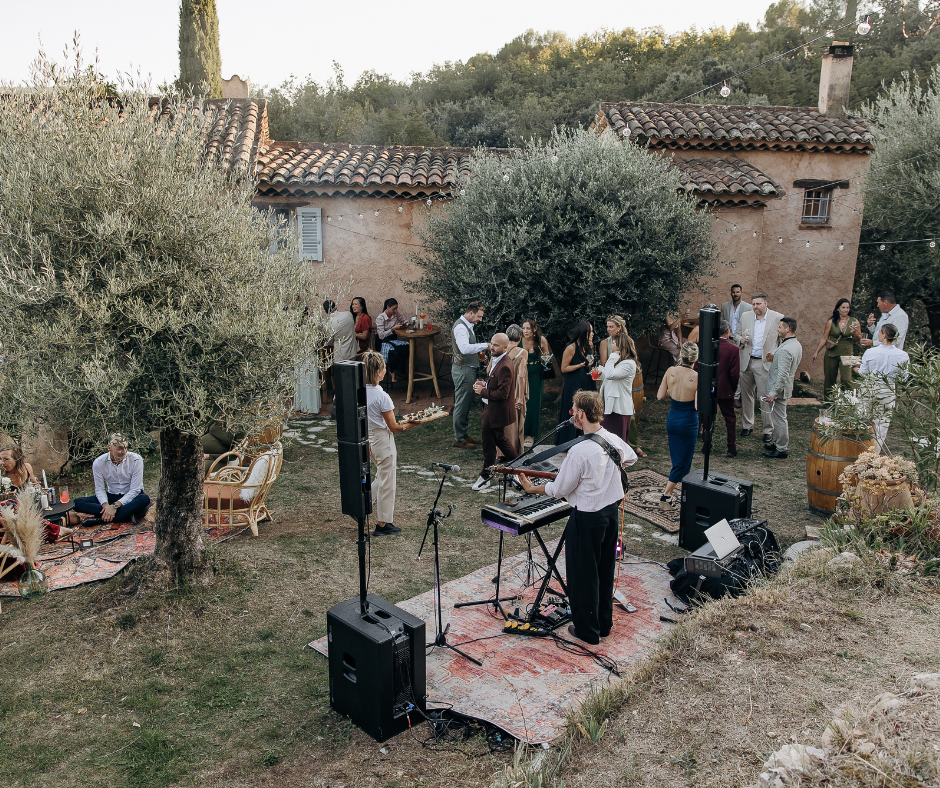
Most couples understand that venues and photographers book early. Music often gets left until much later, but if you want a specific band, DJ or musician, waiting can seriously reduce your options, especially for Saturdays between May and September.
Start by thinking about the whole day rather than simply saying, “we need a band.” You might want a singer or instrumentalist for the ceremony, an acoustic duo during cocktails, a band after dinner, a DJ afterwards, a DJ + sax combination, or one versatile act that can cover several parts of the day.
You do not necessarily need to book all of those, but understanding the shape of the day early helps you build the right entertainment rather than collecting separate performers later.

Think about the energy of the wedding
This is often much easier than choosing genres.
Instead of telling us, “we like indie, some soul, a bit of house, nothing cheesy except maybe some cheesy songs,” tell us what you want the party to feel like.
Do you want everyone singing? A proper festival feel? Elegant cocktails followed by an all time showdown? A club-style party? A relaxed dinner that gradually turns into dancing?
That information often tells us far more about the right band than a playlist does. There is no single “best wedding band”; there is a band that suits your wedding.
Don’t forget that it might be a whole weekend
Destination weddings rarely involve everybody travelling hundreds of kilometres for six hours, so it can be useful to think beyond Saturday.
Friday might be welcome drinks with an acoustic musician or DJ. Saturday could include ceremony music, cocktail entertainment, a live band and a DJ. Sunday might be a relaxed brunch with something acoustic.
You absolutely do not need music at every stage, but planning the weekend as a whole can stop Saturday carrying the entire weight of the celebration. Sometimes the relaxed welcome party ends up being just as memorable as the wedding itself.
Send save-the-dates earlier for a destination wedding
Your guests need more notice than they would for a wedding down the road.
They may need to book flights, hire cars, accommodation, childcare and annual leave, so around 9 to 12 months’ notice is a sensible target for a destination wedding in France, particularly for peak summer weekends.
If your wedding falls during school holidays, a bank-holiday weekend or another busy travel period, earlier is even better. You don’t need every detail ready; you just need the date and enough location information for people to start planning.
Build the day before choosing every song
One of the easiest early-planning rabbit holes is music.
Couples start creating ceremony playlists before they know whether the ceremony will last twenty minutes or an hour, but you don’t need that yet. Start with the structure: guests arrive, ceremony, drinks, dinner, speeches, first dance, party.
Once the timeline exists, choosing where live music fits becomes much easier. The songs can come later.
Book the wedding you actually want
Possibly the most useful thing to remember in the first few weeks after getting engaged is that you do not need to immediately become good at weddings. Most people have never organised one before. You’re allowed to change your mind, ignore traditions you don’t care about and spend more on the things that genuinely matter to you.
You’re allowed to have a huge château wedding. You’re also allowed to have 30 people, an amazing dinner and a brilliant band. The important thing early on is to decide which parts of the wedding actually matter to you, then put your budget and energy there.
Everything else can follow.
Just got engaged and thinking about getting married in France?
Après Ski Bands works with couples planning weddings throughout France and Europe, providing everything from ceremony musicians and acoustic duos to DJs, saxophonists and full live bands.
If you already have a date and venue, send them over. If you have absolutely no idea what kind of music you want yet, that’s fine too.
We can help you work out which options actually make sense.
Because right now, you have quite enough other things to Google or ask AI.